- Category
- War in Ukraine
What Are Iranian Shahed Drones Capable of? From Ukraine to Dubai and US Bases in the Gulf
Shahed attack drones are now spreading across the Gulf. With new capabilities like deploying FPVs midair, transmitting flight data via mobile networks, and resisting jamming, they are enabling asymmetric warfare by replacing expensive missiles. As Iran unleashes its drone arsenal in the Middle East and even Europe, the attacks mirror tactics Russia has used against Ukraine.
 Prefer U24 Media on Google
- Authors

-554f0711f15a880af68b2550a739eee4.jpg "Photo of Lucile Brizard")
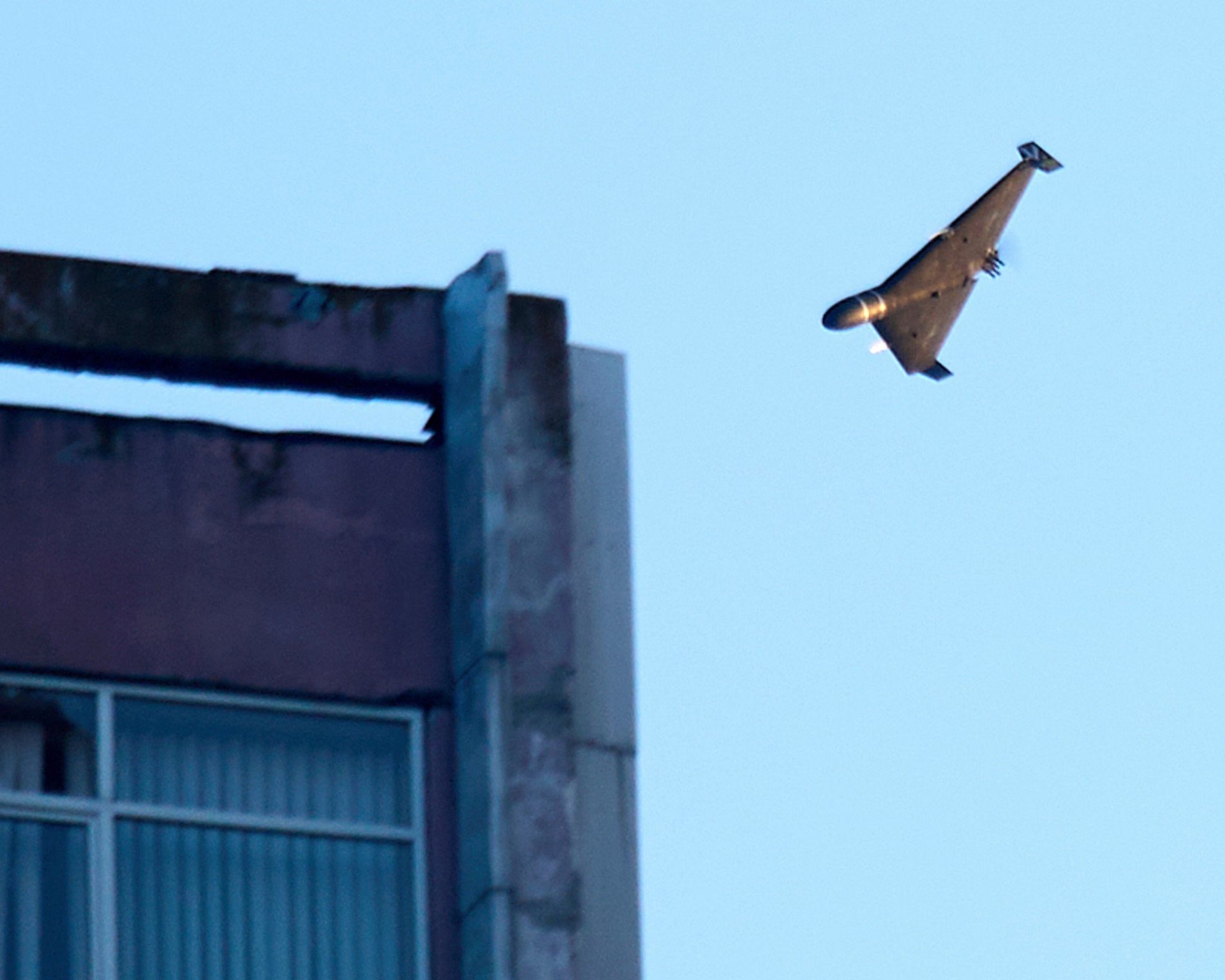
This weekend, a woman standing near Dubai’s Palm Jumeirah Fairmont Hotel looked up and thought she was watching a bird fall from the sky. Instead, she saw a triangular-shaped drone tilt sharply to the left and crash into the ground.
As Iran retaliated following a major US-Israeli bombing campaign that included the killing of Supreme Leader Ayatollah Ali Khamenei, the world watched the drones appear all over the Middle East.
A regular fixture in Ukraine since the beginning of Russia’s full-scale invasion, these drones are known here simply as a “Shahed.” Ukrainians can recognize the sound, having been awakened night after night by its loud, haunting buzz, comparable to a dirt bike.
Now the same sound can be heard over Bahrain, Dubai, and near United States military facilities in the Gulf. So what, precisely, is a Shahed drone, and what other upgrades can it have?
What is a Shahed drone?
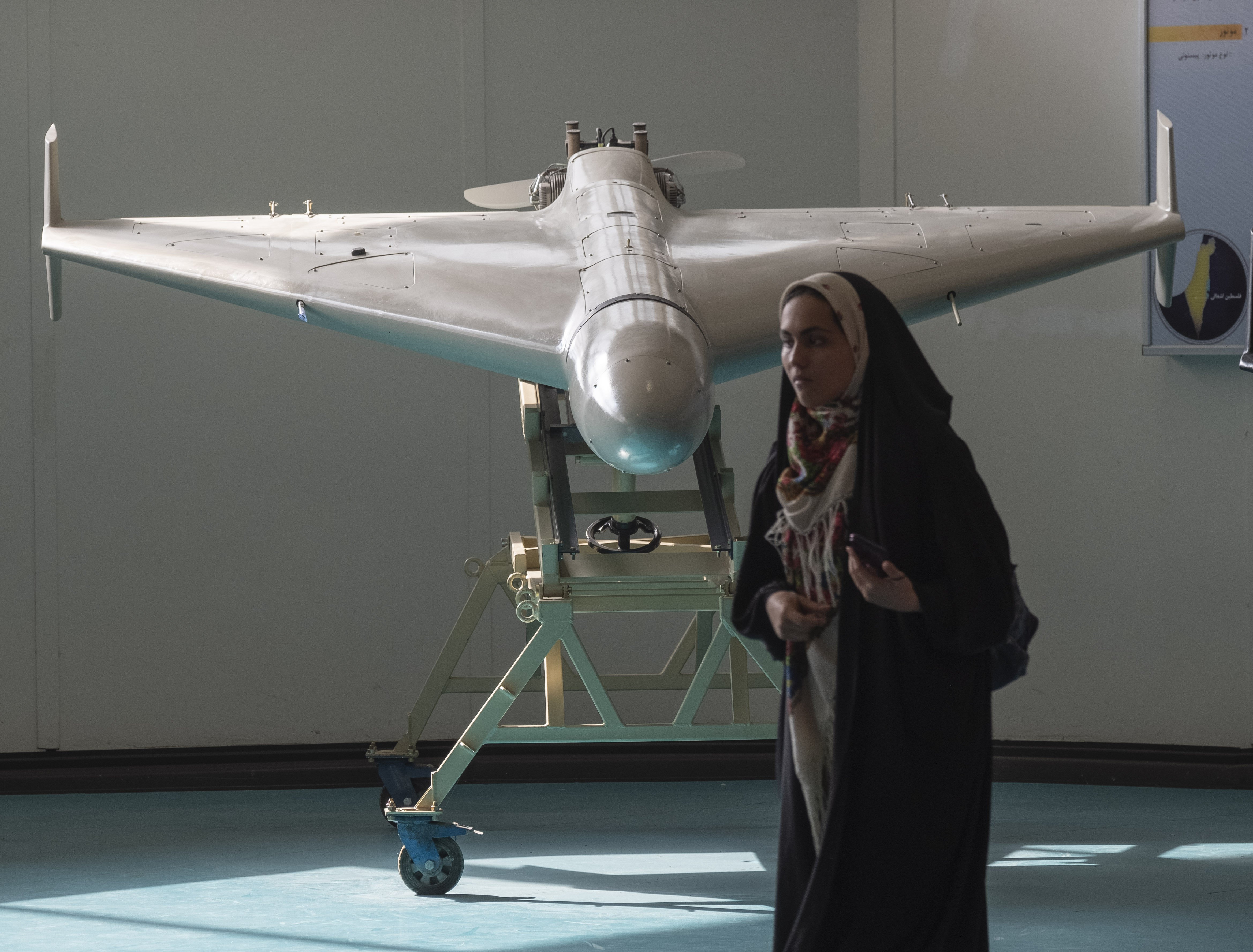
A Shahed drone is a long-range, one-way attack unmanned aerial vehicle designed to strike a fixed target and explode on impact. The most widely used versions, the Shahed-131 and Shahed-136, are Iranian-designed systems that function in practice like slow-moving, propeller-driven cruise missiles.
Launched from racks or truck-mounted containers, the drones fly at low altitude along preprogrammed routes using satellite navigation and onboard inertial systems. They carry explosive warheads estimated at 10 to 20 kilograms in the Shahed-131 and 20 to 40 kilograms in the larger Shahed-136. Their range is roughly 700–1,000 kilometers for the 131 and 1,000–2,000 kilometers for the 136.
Russia has used the Shahed at an industrial scale against Ukraine. Russia launched tens of thousands of Shahed-type and related assault drones in 2025 alone, Ukrainian military and intelligence data suggest. One review estimates that about 32,200 of those were specifically classified as Shahed-type strike UAVs.

On the night of September 20, 2025, Russian forces launched 579 Shahed strike drones in a single assault—one of the largest drone barrages of the war.
Shahed upgrades
Airborne launch platform
Ukrainian military officials say Russian forces have begun adapting Shahed-type drones to carry smaller first-person-view, or FPV, drones. In documented cases, a single Shahed has transported two FPV drones and released them midair, allowing the smaller aircraft to proceed independently toward separate targets. The adaptation turns one long-range strike drone into a kind of airborne launcher, multiplying the number of threats and widening the angles from which defenses must respond.
Mobile-network control
Another development involves leaked documents from Russia’s Alabuga Special Economic Zone indicating that Moscow has tested and upgraded Shahed-type drones abroad, including in Kazakhstan and Türkiye, while fitting them with SIM cards from European mobile operators to enhance navigation and data transmission.
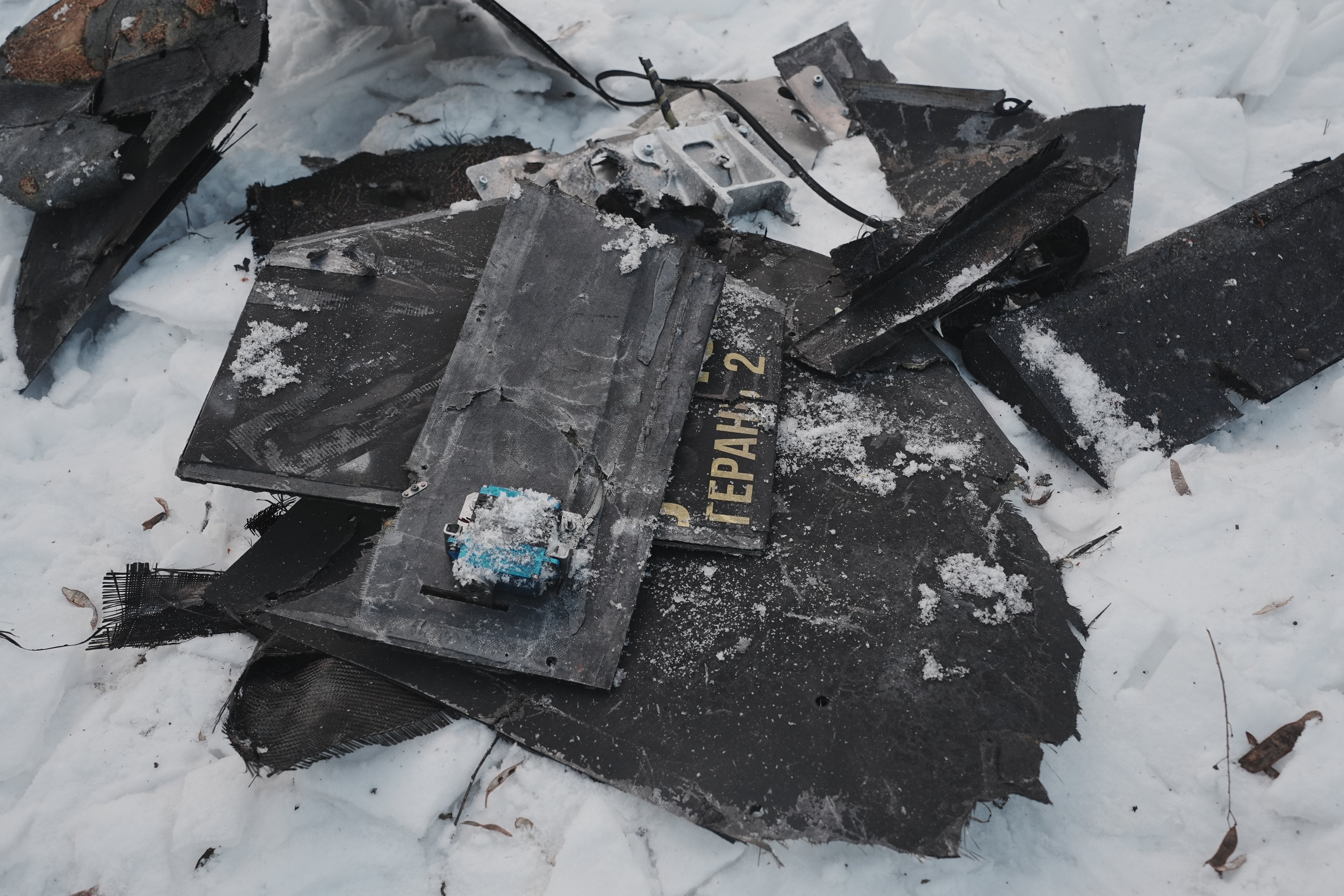
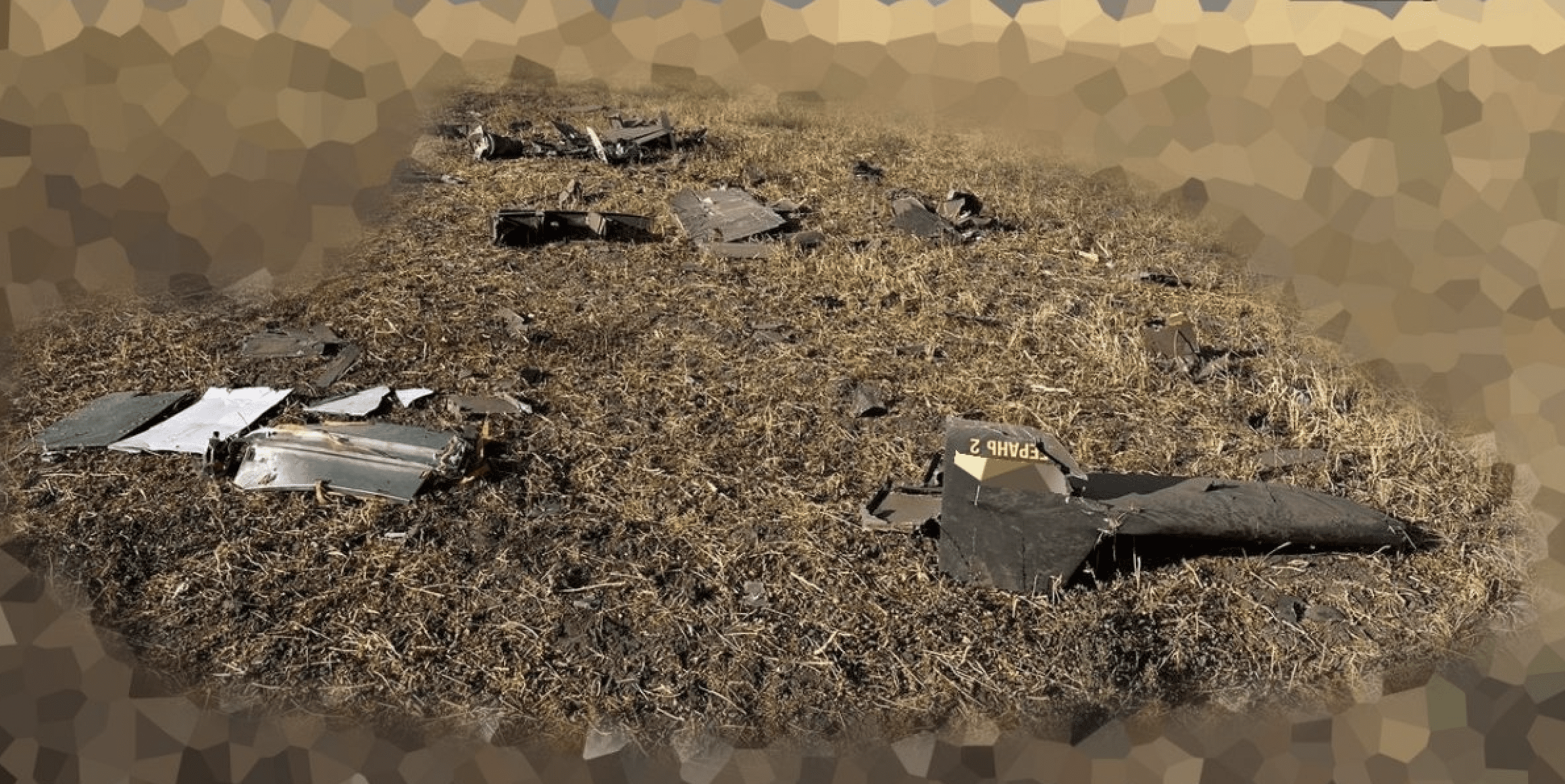
In March 2025, a drone resembling a Geran-2—Russian-made version of a Shahed drone—was found intact in Kazakhstan’s Taskala district, raising questions about cross-border testing. The documents indicate that the drones use SIM cards from countries such as Ukraine, Poland, Romania, and Lithuania to transmit telemetry data, including speed and altitude, and in some cases images or live video, back to operators.
Russian technician Timur Konovalov was reportedly sent to Kazakhstan in 2024 to test SIM card functionality in drone trackers, underscoring efforts to refine their performance outside Russia. Analysts say the use of foreign mobile networks could allow drones to operate more flexibly and complicate detection, fueling concern in Europe as sightings of unidentified drones near strategic sites increase.
Using Starlinks
In another update, Ukrainian expert Serhii “Flash” Beskrestnov reported that Russian forces may have used Shahed drones operated via Starlink satellite internet near Kropyvnytskyi. These drones appeared to be manually guided via live video, without the nearby relay UAVs normally required for long-range radio control, suggesting the possible use of satellite connectivity, such as Starlink.
Earlier reports in 2024 showed downed Shahed drones possibly fitted with Starlink terminals, indicating attempts to expand the drones’ communication capabilities. Russia is believed to have obtained Starlink through various means, including purchases from third-party countries and illicit channels, as purchases are restricted by SpaceX to Russia.
Operator-assisted targeting
There are also indications that some Shahed variants are being fitted with forward-facing cameras and communications modems, enabling limited remote control or real-time adjustments in the final stage of flight. Traditionally, drones have relied on preprogrammed GPS coordinates. The addition of video links and data transmission suggests a shift toward more flexible, operator-assisted targeting.
Speed improvements
Speed is another variable. Ukrainian officials and defense analysts report that Russia is experimenting with jet-powered derivatives of the Shahed design. These versions are significantly faster than the familiar propeller-driven models, which are known for their slow, buzzing approach. Higher speeds narrow interception windows and strain air defense systems calibrated for slower targets.
EW resistance
Navigation systems are also being adapted to withstand electronic warfare. Investigators examining downed drones have found evidence that some variants use cellular networks or satellite links to supplement or bypass standard GPS guidance. Such modifications make them more resistant to jamming and signal disruption, tools that have been central to Ukraine’s defensive strategy.
Air-defense deterrence
Another tactical advance is Russia’s adaptation of a Soviet-era R-60 air-to-air missile on Shahed drones, mounting it backward to target Ukrainian helicopters intercepting the drones. Captured in footage from February 8, this modification allows the drone to carry out its primary strike mission while also posing a secondary threat to low-flying aircraft. Equipped with two cameras, communications via a Chinese mesh modem, and Russian-made satellite navigation, the drone is designed to operate under electronic warfare conditions. This adaptation marks Russia’s continued efforts to weaponize Shahed drones with legacy Soviet missiles, following earlier sightings in late 2025.
Simple design, large impact
The drone’s effectiveness lies not in sophisticated engineering but in its simplicity.
The Shahed-136 has a distinctive triangular, delta-wing shape. It is powered by a small piston engine that drives a rear propeller. The airframe is built from lightweight materials, such as styrofoam, prioritizing low cost and ease of production over advanced design.
Technical assessments published by the Royal United Services Institute note that the engines are reverse-engineered from civilian models. The Shahed-131 uses a rotary Wankel engine derived from the British AR 731 design. The larger 136 uses a roughly 50-horsepower engine based on the German-designed Limbach L 550.
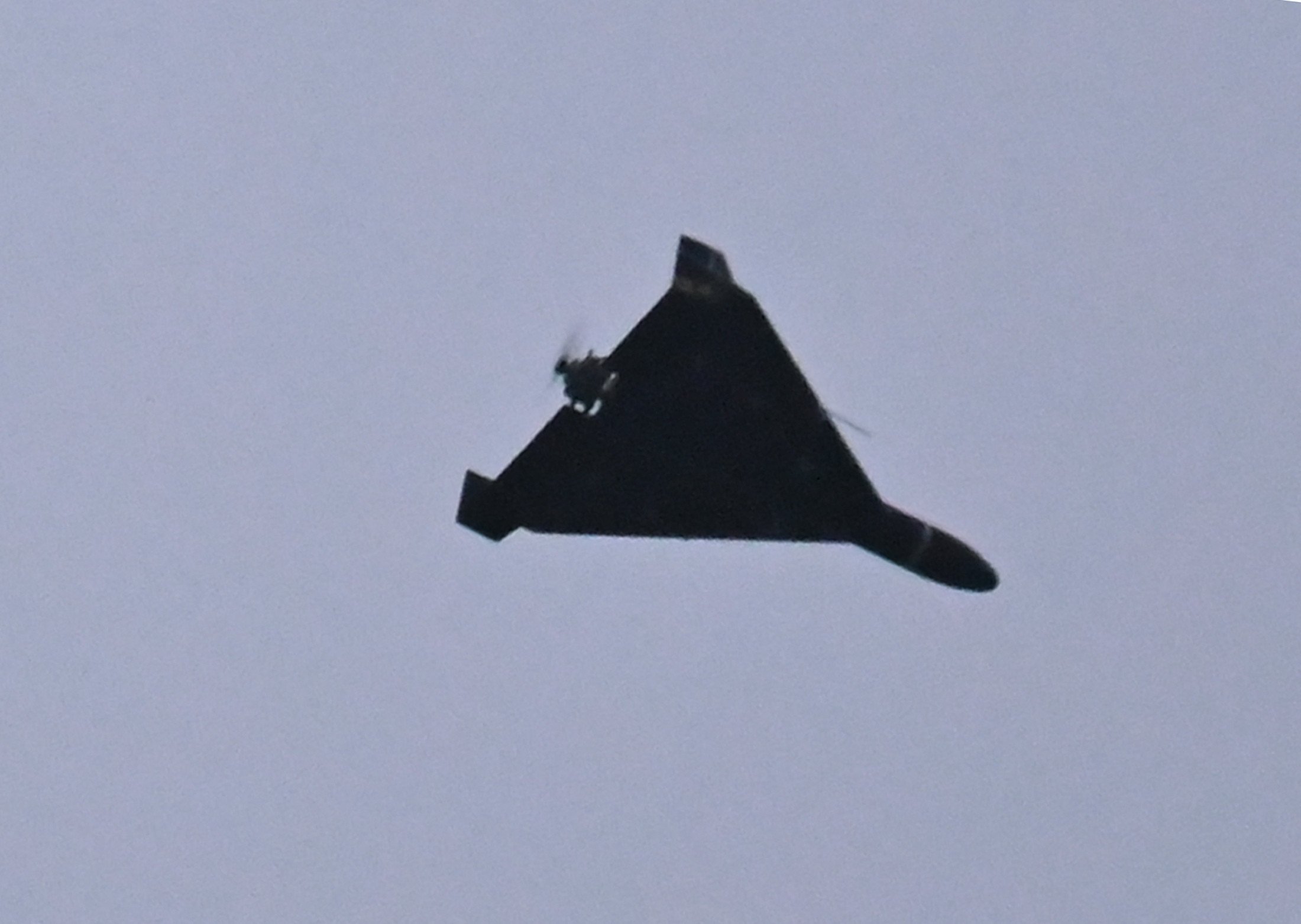
Navigation relies on commercially available technologies, including inertial navigation systems and satellite positioning such as GPS and GLONASS. Some newer variants incorporate digital communication links that allow limited midcourse adjustments.
The design’s relative simplicity keeps costs low. The per-unit cost of Russia’s domestically produced Shahed-type drones, though, is difficult to pinpoint. An Israeli missile expert estimated $20,000–$30,000 per drone in January 2023, while a British analyst, based on a personal inspection of a captured Shahed-136 in October 2022, put it at $80,000. Forbes Ukraine uses $50,000 per drone to calculate the cost of Russian attacks. However, all these estimates were made early in the war. The Shahed-136 is significantly cheaper than traditional cruise missiles, which can cost millions. This price difference enables Iran to use it for asymmetric warfare, allowing for repeated mass deployment.
Production at scale
Iran began supplying Shahed drones to Russia in 2022. Tehran later transferred engineering documentation and production tooling, enabling Moscow to establish domestic production and rebrand the systems as Geran-1 and Geran-2. Geran-2 became central to strikes on Ukrainian energy infrastructure. Russia has largely moved beyond relying on imported Iranian drones.
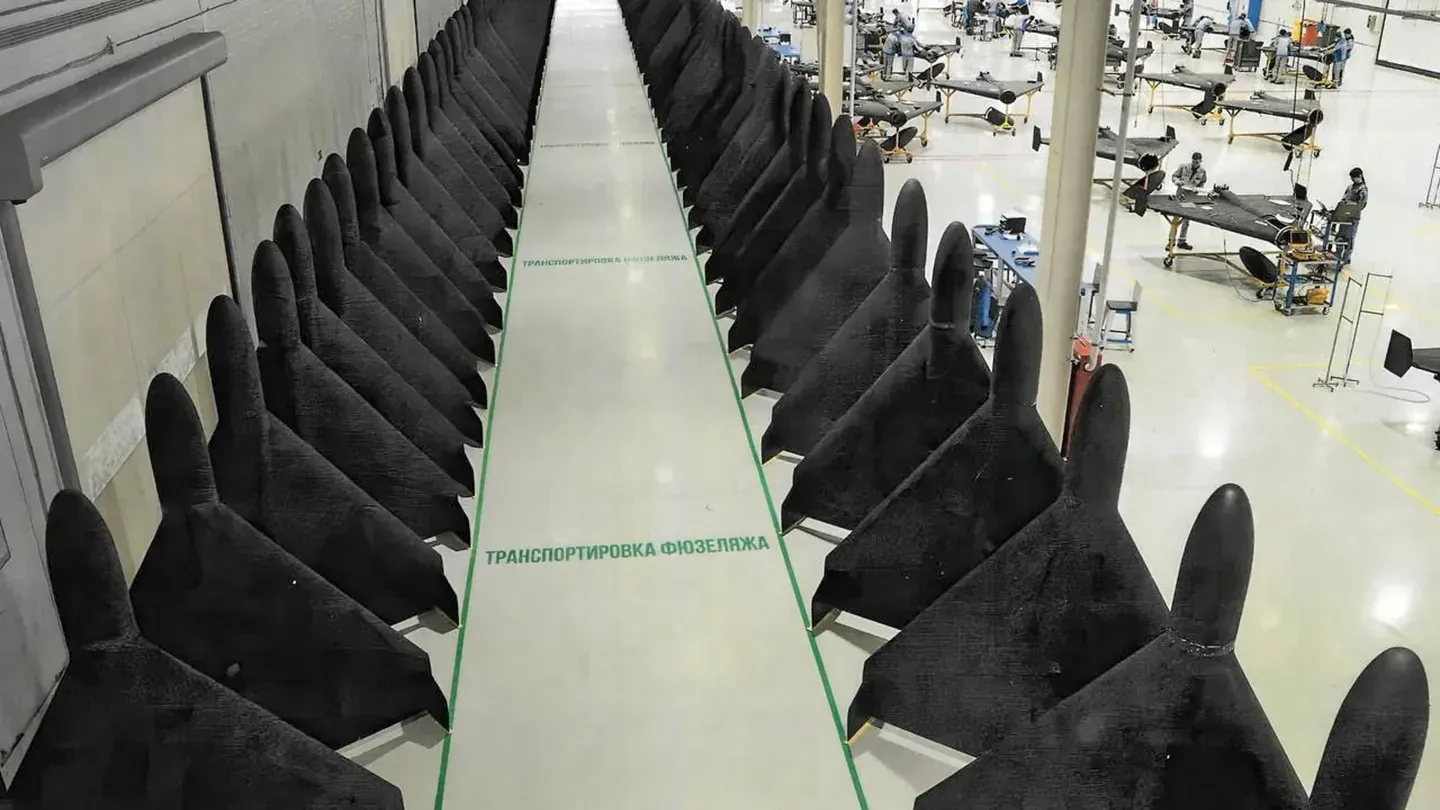
Russia produced more than 6,000 one-way attack drones in 2024, with output increasing into 2025, the International Institute for Strategic Studies reported. Ukrainian Air Force data show a steady increase in drone launches, with 2,300 in November 2024 and 2,696 in January 2025.
Satellite imagery indicates expansion of production facilities in the Alabuga Special Economic Zone in Tatarstan. A second production line is believed to operate in Izhevsk. Newer variants reportedly include jamming-resistant antennae, modified warheads, and datalinks that use mobile networks. Reports of a jet-powered derivative of the Shahed-238 have surfaced but remain unverified.
Russia’s new long-range strike drone, the Geran-5, appears to continue relying on Iranian technology, with analysts noting clear similarities to Iran’s jet-powered Karrar UAV. According to Defense Express and Ukraine’s Main Intelligence Directorate, the Geran-5 shares the Karrar’s low-wing design, turbojet engine mounted above the fuselage, and twin-fin tail, though with a modified wing and smaller engine. Many internal components match earlier Geran models produced at Russia’s Alabuga facility, and officials say Moscow is considering launching the drone from a Su-25 aircraft.
Iran mirrors Russia’s drone war tactics
Recent drone strikes in the Gulf follow patterns seen in Ukraine. The UAE detected 186 missiles and 812 drones, intercepting most. Qatar reported 101 missiles and 39 drones, with a similar interception rate. Bahrain destroyed 73 missiles and 91 drones, while Kuwait intercepted 178 missiles and 384 drones. No data was available for Saudi Arabia or Oman, highlighting the growing security threat in the region.
Yesterday, a suspected Iranian drone struck the parking lot of the US consulate in Dubai.
A Video verified by The Wall Street Journal showed strikes on airports, seaports, high-rise towers, and a United States naval base in Bahrain. At least three people were killed in strikes in the United Arab Emirates and one in Oman.
Regional defense reporting has suggested that Iran may hold a stockpile of up to 80,000 Shahed loitering munitions and could be producing hundreds more each day. The figures remain unverified, but they have sharpened concern among military planners who view them as evidence of a shift toward warfare defined less by precision and more by sustained, industrial-scale attrition.
“Iran watched Russia use the same tactics for four years,” said Samuel Bendett, an adviser with CNA. In Ukraine, Russia deployed Shahed drones in waves to stretch air defenses and place constant pressure on energy grids and cities.
In the Gulf, residents have begun describing the same distant buzzing Ukrainians have recognized since 2022. The defining characteristic of the Shahed is not a single strike but scale—long range, low cost, and the ability to launch hundreds at a time. In Ukraine, it became a nightly fixture. Now it is appearing elsewhere.
Discuss this article:
-9a7b3a98ed5c506e0b77a6663f5727c5.png)


-c439b7bd9030ecf9d5a4287dc361ba31.jpg "Photo of Katherina Popilnichenko")



-29a1a43aba23f9bb779a1ac8b98d2121.jpeg "Photo of Illia Kabachynskyi")