- Category
- War in Ukraine
Russia Keeps Flying Drones on Civilian Tech While Complaining About Starlink in Ukraine
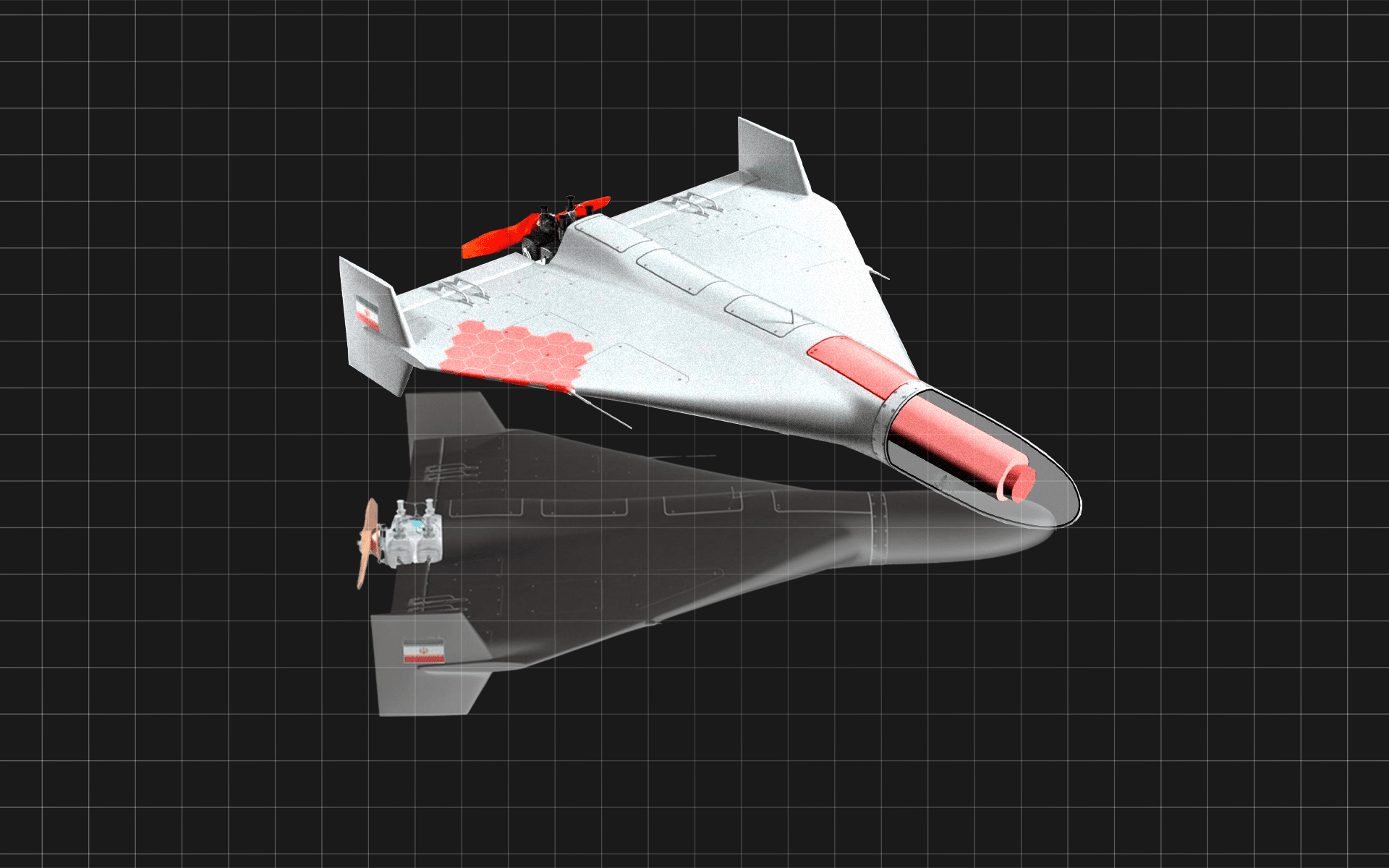
From fitness watch chips to dishwasher semiconductors, both Russia and Iran have long relied on dual-use civilian technologies to build weapons used in devastating attacks on Ukrainian peaceful cities.
 Prefer U24 Media on Google
- Authors

-46f6afa2f66d31ff3df8ea1a8f5524ec.jpg "Photo of Jess Daly")
As soon as Starlink terminals linked to Russian military units were shut down, Russia and Iran started accusing Elon Musk’s Starlink satellite network of violating international law. Speaking at a United Nations conference on the peaceful use of outer space, Moscow claimed that Musk was blurring the line between civilian and military technologies.
For Ukrainians, @ElonMusk’s @Starlink provides a critical lifeline. pic.twitter.com/1du5j18Sbt
— UNITED24 Media (@United24media) February 2, 2026
Yet, since the start of Russia’s full-scale invasion of Ukraine, Moscow has had no problem exploiting civilian technology for its war.
Russian forces have illicitly used Starlink terminals to enhance battlefield communications and operate drones. The Iranian-designed Shahed drone has been turned into a long-range loitering munition capable of reconnaissance and strikes against moving targets—increasing its effectiveness against both military and civilian infrastructure.
The consequences have been devastating. Russia has targeted Ukraine’s logistics routes and terrorized civilians in what’s grimly called a “human safari.” In March 2025 alone, Kherson endured between 600 and 700 drone attacks per week. Pedestrians, civilian vehicles, residential buildings, medical facilities, emergency responders, and public transport are all regular targets.
Kherson continues to suffer from targeted Russian drone attacks — a brutality locals call “human safari.”
— UNITED24 Media (@United24media) December 11, 2025
This weekend, people in 40 cities across four continents will rally in solidarity with Kherson.
🔗 https://t.co/MX4m2zJEWM pic.twitter.com/mwQtwqQcYe
SpaceX operates a constellation of roughly 9,600 Starlink satellites. Despite repeated claims from Moscow, Russia was never authorized to use the system for military purposes. Investigations indicate that Russian forces obtained terminals through illicit procurement networks and activated them outside approved jurisdictions.
Following the shutdown of some terminals, Russia is reportedly pressuring relatives of Ukrainian prisoners of war to register Starlink terminals in their own names—exploiting vulnerable families in an attempt to sustain battlefield connectivity.
Starlink is just one example of how Russia and Iran have exploited dual-use civilian technologies—including everyday household components—to fuel military attacks in Ukraine.
Western components to strike Ukraine
In one night alone, Russia struck Ukraine with 549 missiles and drones containing over 100,000 foreign-made components from the US, China, Taiwan, the UK, Germany, Switzerland, Japan, South Korea, and the Netherlands, on October 5, 2025.
Throughout Russia’s invasion of Ukraine, Western-made components have been found in Iran’s Shahed-131 and Shahed-136 drones used by Russia, as well as in every Russian missile—including Kh-101, Kinzhal, Kalibr, Iskander, Tsirkon, Kh-59—fighter jets, the Ka-52 “Alligator” helicopter, and drones like the Orlan.
Russia has found loopholes to evade sanctions and now is importing large amounts of critical components for its missiles and drones, according to a report by KSE and the Yermak-McFaul International working group. pic.twitter.com/STkaivnbH7
— UNITED24 Media (@United24media) March 31, 2024
Sanctions on technologies, like semiconductors, were imposed on Russia to limit its ability to wage war. These measures ban the sale, supply, transfer, or export—directly or indirectly—of goods that could strengthen Russia’s industrial capacity. This includes “dual-use” items, which can serve both civilian and military purposes.
Despite strict US and European sanctions on such goods, both Russia and Iran have repeatedly bypassed controls through front companies, shell corporations, and other opaque schemes.
Microcontrollers for Russian UAVs are manufactured in Switzerland; microcomputers for drone flight control in the United Kingdom; optoisolators for cruise missiles in Japan; switching connectors in Germany; processors in the Netherlands; and servomotors and bearings in the Republic of Korea, Ukraine’s President Volodymyr Zelenskyy announced.
In 2023, $5 billion worth of Western-sanctioned goods disappeared during transit through Russia, many of which were dual-use.
Every Russian missile and every Russian attack drone also contains parts that are still being supplied to Russia from Western countries and various countries close to Russia. Now, in the fourth year of the full-scale war, it is simply strange to hear anyone claim they don’t know how to stop the flow of critical components.
Volodymyr Zelenskyy
President of Ukraine
Dishwashers and refrigerators to tanks
Semiconductors taken from dishwashers, refrigerators, and other commercial and industrial machines have been found in Russian tanks since the start of the full-scale invasion, US Secretary of Commerce Gina Raimondo reported.

AO Gazprom Household Systems—a subsidiary of Russian state gas giant Gazprom —even began planning to produce washing machines and refrigerators in 2025.
While it's not clear whether the company will produce these kitchen appliances for genuine civilian purposes, Russian forces have also been found to loot these household items from Ukrainian homes.
Igor Yevgenyevich Konashenkov said, on behalf of the Russian Ministry of Defense, that their forces heroically captured another washing machine from Ukraine. pic.twitter.com/zx1MafrIa9
— NOELREPORTS 🇪🇺 🇺🇦 (@NOELreports) July 29, 2023
Fitness watches to drones
Wearable fitness devices, which rely on micro-electromechanical systems (MEMS), have been exploited by Iran as dual-use civilian technology to advance its drone program.
MEMS, which measure motion and orientation in products like fitness trackers and smartwatches, can also be adapted for drone navigation systems.
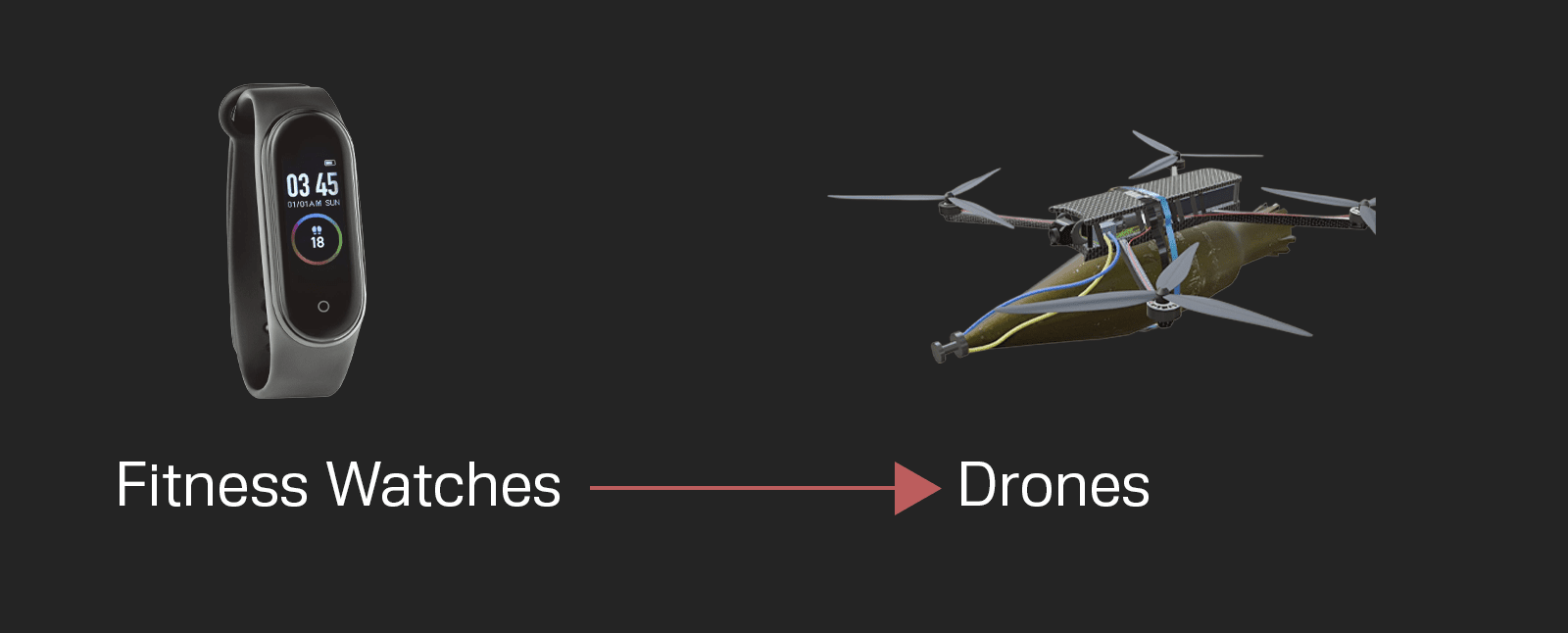
US prosecutors charged two Iranian men—Mahdi Mohammad Sadeghi, co-founder of a US fitness wearable company, and Mohammad Abedini—for conspiring to illegally export US-origin MEMS to an Iran-based supplier linked to the Islamic Revolutionary Guard Corps (IRGC) in 2025.
Abedini co-founded San’at Danesh Rahpooyan Aflak Co. (SDRA), which manufactures the Sepehr Navigation System, primarily designed for use in drones, cruise missiles, and ballistic missiles. SDRA uses MEMS, which are considered dual-use civilian goods, so Abedini was once granted permission by Geneva airport officials to carry SDRA parts in his luggage on a flight to Tehran.
Similar components in the Sepehr navigation system were found in an Iranian-made Shahed drone used in an attack on the US base “Tower 22” in Jordan in January 2024, killing three US soldiers and injuring 40 others.
Sepehr sales skyrocketed by more than 500% after Iran began shipping Shahed drones to Russia in 2022, making it likely that SDRA-manufactured components have also guided attack drones to targets in Ukraine, according to Iran Watch.
SIM cards flying Russian Shaheds
Russia has been acquiring and installing European SIM cards into its Shahed-type Geran-2 drones. The SIM cards are placed in the drones’ GPS trackers to transmit telemetry data such as speed, altitude, and location back to operators, and even relay photos and live video, helping Russia refine navigation and bypass Ukraine’s air defenses.
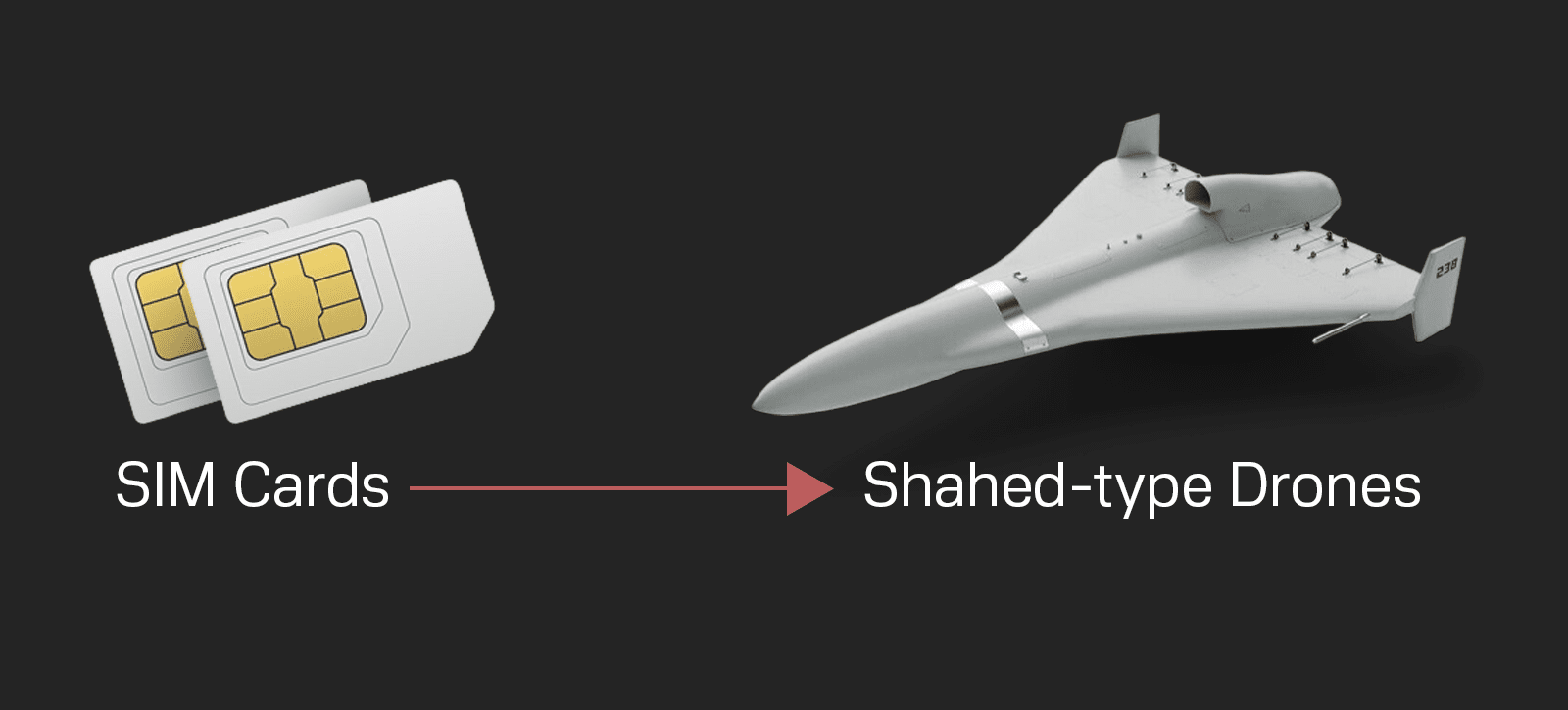
Russia has reportedly tested these drones abroad, including in Kazakhstan and Türkiye—raising concerns about Russia’s broader drone testing activities, and whether these drones could potentially be deployed against European countries, using mobile networks to control and monitor their movements.
CNC Machines for drones, missiles, and armoured vehicles
CNC machines are computer-controlled tools that cut and shape materials with high precision, used in everything from electronics to aircraft—and in the military, they produce critical components for drones, missiles, and armoured vehicles.
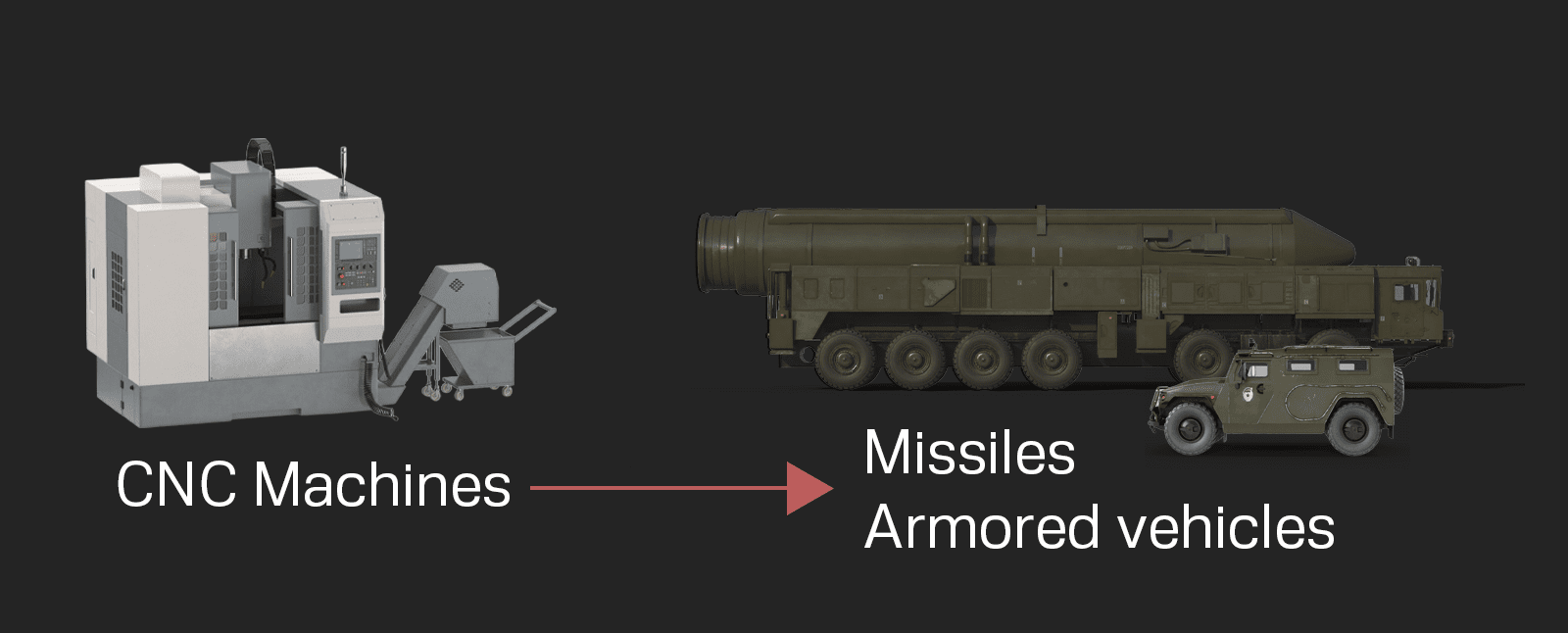
China has provided Russia with advanced machinery, tools, and CNC components critical to the production of nuclear-capable hypersonic missiles, such as the Oreshnik. Russia used an Oreshnik missile to strike the Ukrainian city of Lviv, in January 2026.
Chinese-supplied machinery and dual-use technology to Russia is estimated at $10.3 billion, supplying plants such as the sanctioned Votkinsk Machine Building Plant—a key facility for Russia’s missile program that produces the Oreshnik, Iskander-M, and Topol-M systems. In addition to CNC components, China has provided a wide array of parts for high-precision weapons and military aviation, including:
Microchips and memory modules worth approximately $4.9 billion.
Ball bearings valued at $130 million, considered critical for aerospace applications.
Piezoelectric crystals used in radar systems and electronic warfare platforms estimated at $97 million.
Telescopic optical sights and calibration instruments for weapons testing.
All of these items are restricted for export to Russia by 39 Western-aligned countries, yet China has not participated in these sanctions.
Bearings for tanks, missiles, and drones
Roller bearings, which reduce friction and support rotating parts, are used in everything from vehicles and industrial machinery to household appliances. These precision bearings are also essential for reducing friction in tanks, drones, missiles, and other weapons systems.
Tens of millions of dollars' worth of bearings were shipped to Russia in the first half of 2024 from a range of foreign manufacturers in Malaysia, Spain, Czechia, Germany, Japan, Vietnam, and Uzbekistan, customs data obtained by UNITED24 Media showed.

The world’s largest bearing manufacturer, Sweden’s SKF, announced in April 2022 that it had ceased all operations in Russia. Yet, at the time of reporting in January 2025, it remained one of Russia’s top suppliers.
A Slovak company, Kinex Bearings A.S., was also found to have shipped over $1.1 million worth of bearings to its Russian subsidiary, Kinex Rus LLC, via Turkish intermediaries.
While accusations fly over Starlink, it is Russia and Iran that have consistently exploited dual-use civilian technologies to fuel attacks on Ukraine. Despite sanctions on semiconductors, bearings, and other dual-use items, complex supply chains and third-country intermediaries continue to supply critical components—showing how deeply dual-use technology has become embedded in modern warfare.
Discuss this article:


-c439b7bd9030ecf9d5a4287dc361ba31.jpg "Photo of Katherina Popilnichenko")

-72b63a4e0c8c475ad81fe3eed3f63729.jpeg "Photo of Cyril Barabaltchouk")