- Category
- War in Ukraine
Four Years of Russia’s War in Ukraine by the Numbers

Four years after Russia launched its full-scale invasion of Ukraine, the war can be counted in numbers: 212,947 documented war crimes, thousands of civilians killed, and millions displaced. Dive into the verified figures that define Russia’s war against Ukraine.
 Prefer U24 Media on Google
- Authors

-24deccd511006ba79cfc4d798c6c2ef5.jpeg "Photo of Louis Beaudemont")
The figures from four years of Russia’s full-scale invasion of Ukraine are staggering. They directly contradict Russia’s narrative, which continues to describe the war as a “special military operation” and hides the phenomenal cost of it.
As of January 2026, Ukraine’s Prosecutor General has documented more than 212,947 war crimes committed by Russia against Ukraine and its people, with between 200 and 300 new crimes recorded each day.
We bring you stories from the ground. Your support keeps our team in the field.
These numbers—the dead, the injured, rape, child abductions, destroyed cultural heritage, and damaged or destroyed infrastructure—illustrate the scale and systematic nature of Russia’s military aggression over the past four years. They also reflect Ukraine’s resilience, with or without its partners' support, in the face of a country that still presents itself as a global power but remains bogged down in its fourth year of war.
But even these staggering figures are likely an undercount. Many crimes occur in Russian-occupied or frontline areas that investigators cannot safely access; Russia destroys evidence, witnesses fear reprisals, and entire cases go unreported. The true scale of Russia’s war is almost certainly higher than current verified data can capture.
🔴 Russian drone hits Dnipro apartment building.
— UNITED24 Media (@United24media) January 22, 2026
A Russian drone strike on a residential high-rise in Dnipro has injured seven people, including a 14-year-old girl. pic.twitter.com/8mNUmkGAcU
Russian crimes against civilians
In its February 2026 report, the UN Human Rights Monitoring Mission in Ukraine compiled a list of crimes against civilians based on data from third parties and interviews conducted by the UN.
The findings show both the scale and the systematic nature of violence against civilians. They also highlight a sharp acceleration in 2025, driven by intensified drone and missile strikes on cities, more systematic targeting of civilian infrastructure—including direct attacks on passenger trains in 2025—and what the UN describes as “human safaris” organized by Russian drone operators to terrorize civilians in frontline cities such as Kherson, Sumy, and Kramatorsk.
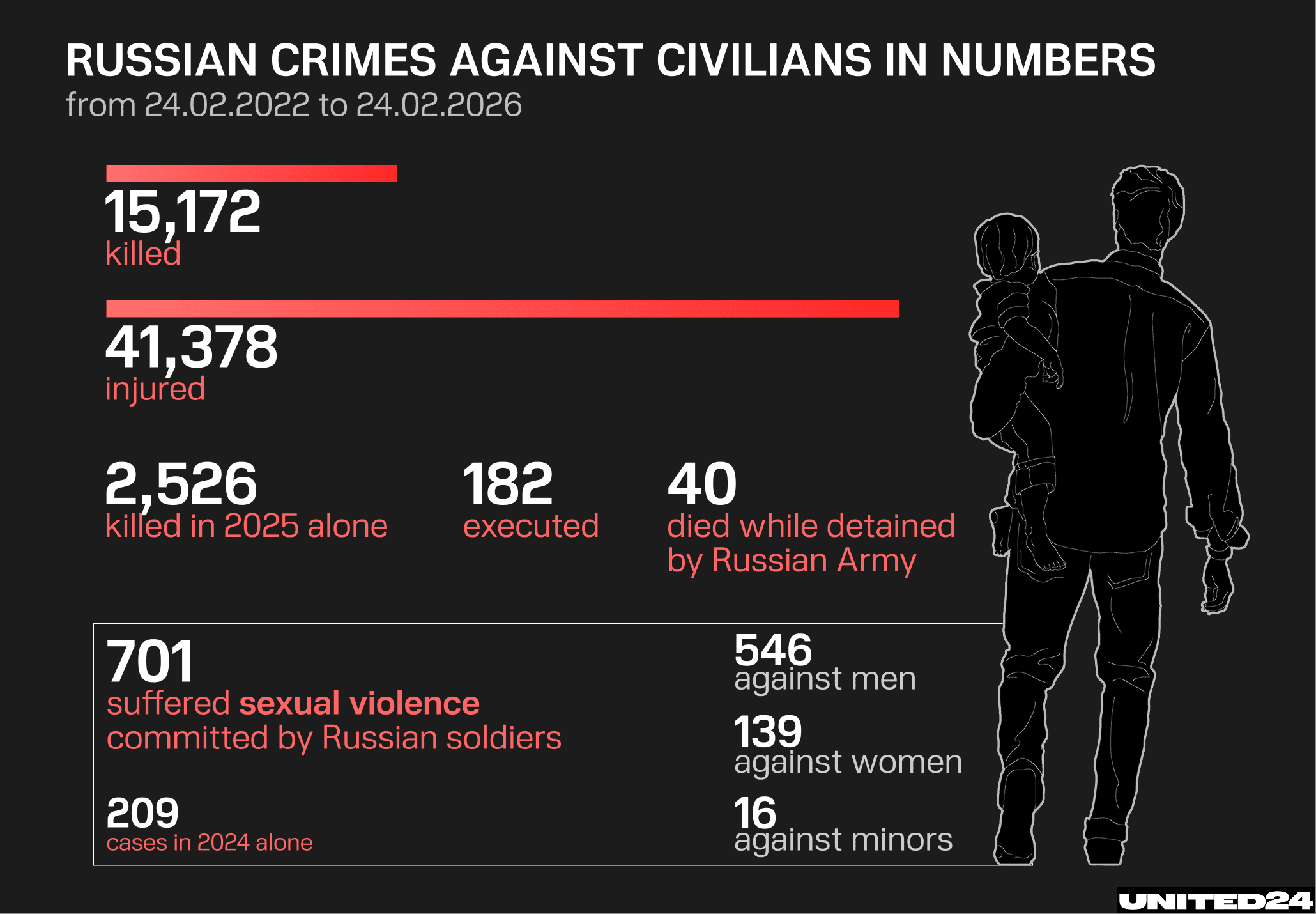
From February 2022 to February 2026, Russian forces killed 15,172 civilians and injured 41,378. In 2025 alone, it killed 2,526 civilians—63% of them in areas close to the front line—an increase of 31% compared to 2024. Russian forces summarily executed at least 182 civilians, and 40 died while detained by the Russian army. Of those who died in detention, 84% had been subjected to torture. Since 2022, 701 civilians (546 men, 139 women, and 16 minors) have suffered sexual violence committed by Russian soldiers, including 209 cases in 2024 alone.
Around 70,000 people are listed as missing due to the war—both soldiers and civilians. They have not reappeared or their bodies have not been found or identified.
“In most cases we will only be able to learn what happened to them after the war ends," says Artur Dobroserdov, the Ukrainian Commissioner for Persons Missing Under Special Circumstances. "Or at least after the active phase of hostilities is over.”
Children killed, injured, or kidnapped in Russia’s war
Children have not been spared. Since 2022, the Russian invasion caused the deaths of 766 children, with 2,540 injured, and 2,290 reported missing. Russia’s abductions and deportations of children led the International Criminal Court (ICC) to issue arrest warrants for Russian leader Vladimir Putin and Russia’s Commissioner for Children’s Rights Maria Lvova-Belova on war crimes charges. Ukraine’s Bring Kids Back initiative, launched in 2023 by Ukrainian President Zelenskyy, has documented 19,546 cases of children forcibly transferred to Russia. Russia claims it has “evacuated” 744,000 children from temporarily occupied territories.
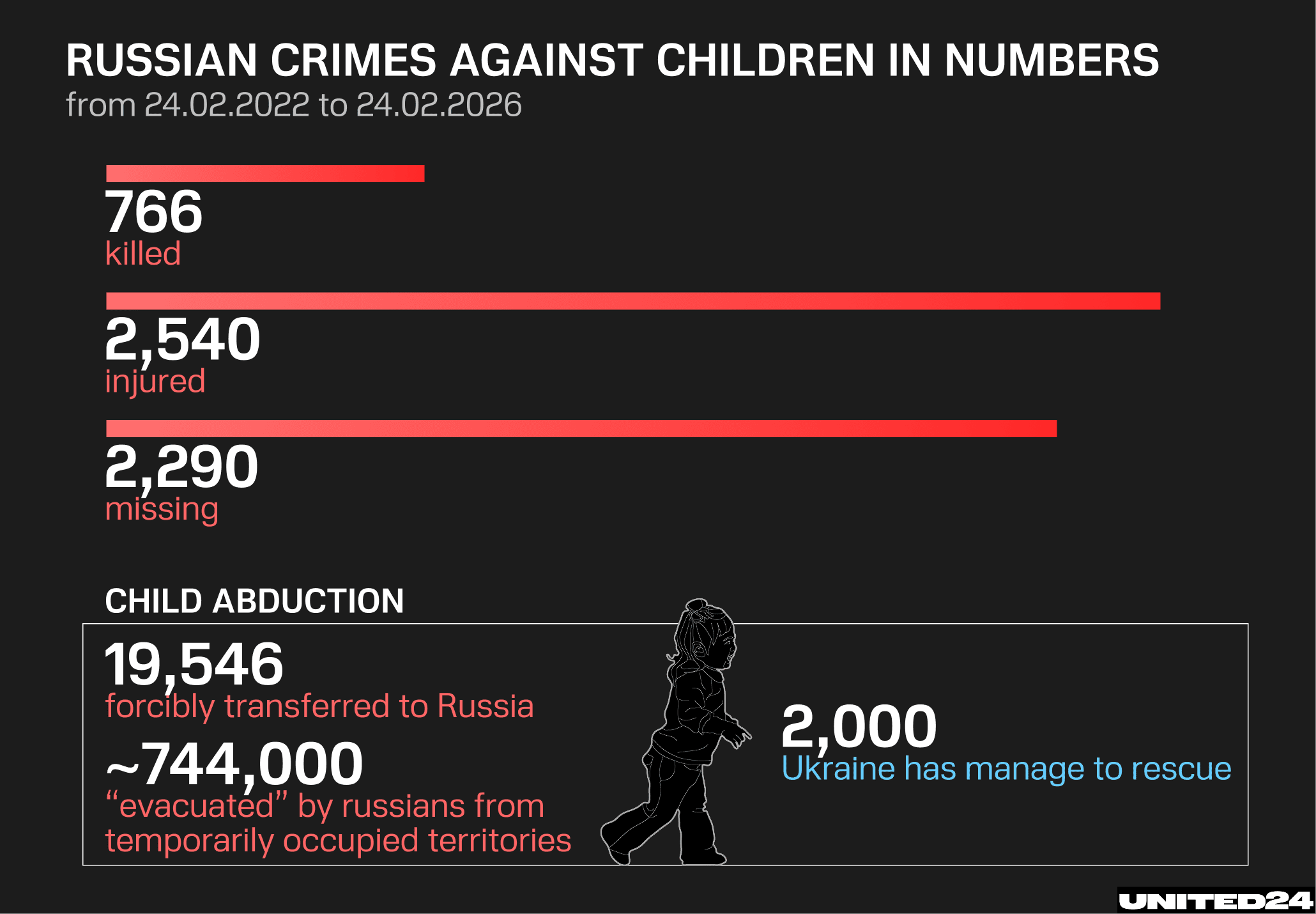
With support from its partners, Ukraine has managed to rescue around 2,000 children since 2022, enabling them to return to Ukrainian-controlled territory and reunite with their families.
Prisoners of war tortured or killed in Russian captivity
Prisoners of war (POW) have also faced systematic abuse. According to the UN Human Rights Monitoring Mission in Ukraine, 96% of the 725 former POWs interviewed reported torture in captivity. Russian forces summarily executed 109 Ukrainian POWs, including 70 in 2024–2025 alone.
A total of 6,266 Ukrainians—including 5,863 military personnel and 403 civilian—have been returned to Ukraine through prisoners exchanges since the start of the full-scale invasion, data released December 10, 2025, by Ukrainian Parliament Commissioner for Human Rights Dmytro Lubinets show.
Journalists whom Russia killed or injured
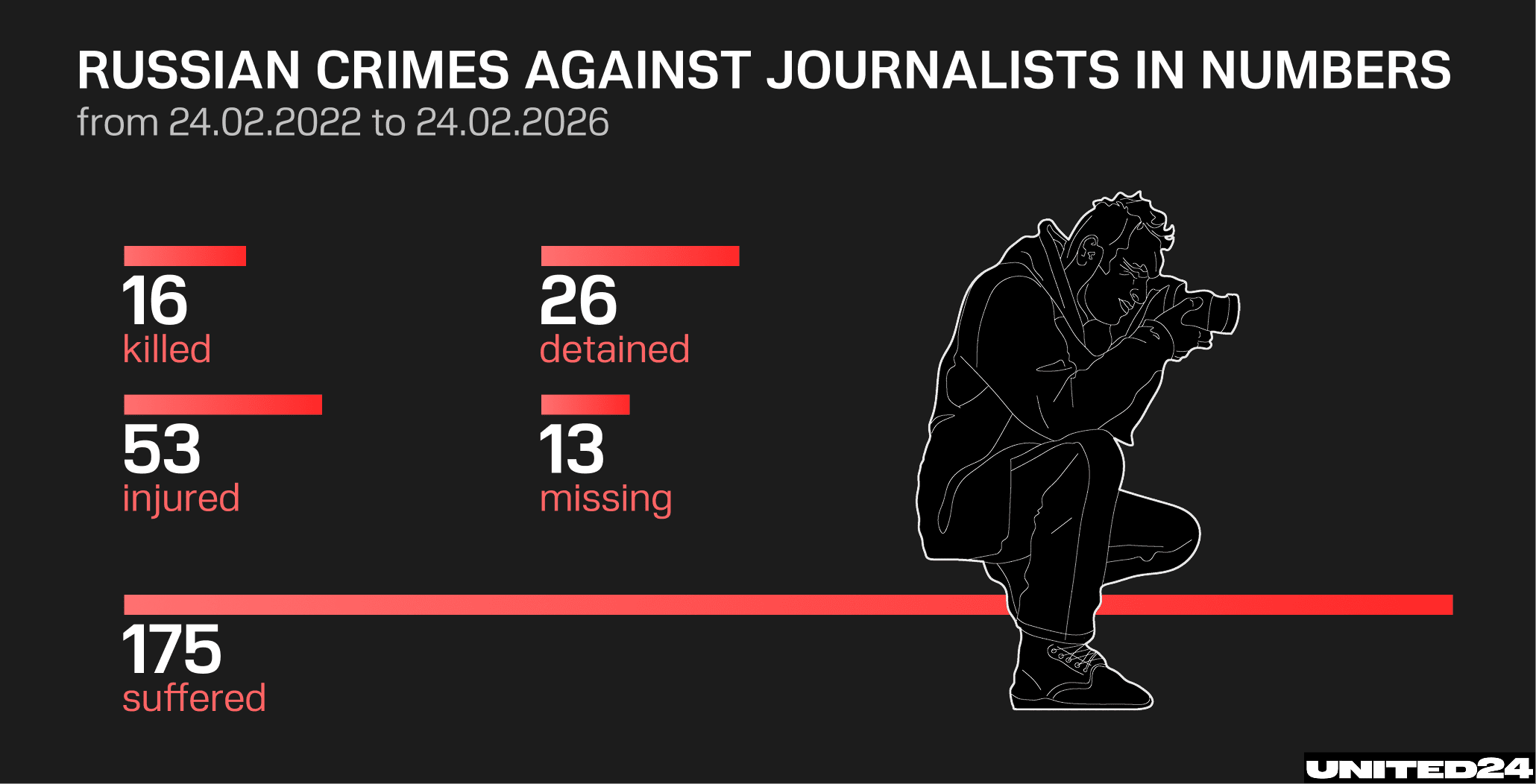
At least 175 journalists have suffered from the Russian war while carrying out their work since 2022, Reporters Without Borders (RSF) reported. Russia killed 16 journalists, while 26 Ukrainian journalists remain detained by Russia.
French photojournalist Anthony Lallican was killed in Ukraine’s Donetsk region after a Russian FPV drone struck his position near Druzhkivka while he was reporting, on Ocotber 3, 2025. Ukrainian journalist Hryhorii Ivanchenko, who was with him, was injured but survived. Lallican was wearing clearly marked press protection.
Few weeks later, UNITED24 Media reporter Philip Malzahn and cameraman Yegor Terletskyi survived a Russian FPV drone attack while reporting near the frontline, escaping their vehicle moments before it was hit.
Russian crimes against infrastructure, heritage, and the environment
Russia’s war has destroyed or damaged at least 235,000 civilian infrastructure facilities since February 24, 2022, Ukraine’s Prosecutor General said in a 2025 report. Attacks on the energy sector alone have wiped out over 50% of Ukraine’s energy generation capacity, leaving several hundred residential buildings in Kyiv without central heating at the time of publication due to targeted attacks.
Russia has also targeted medical facilities, with more than 2,500 damaged or destroyed since the start of the full-scale invasion. Children’s hospitals have not been spared, including the October 29, 2025, strike in Kherson and the July 8, 2024, precision missile attack on Kyiv’s Ohmatdyt Children’s Hospital, which completely destroyed one wing and killed and injured a dozen people.
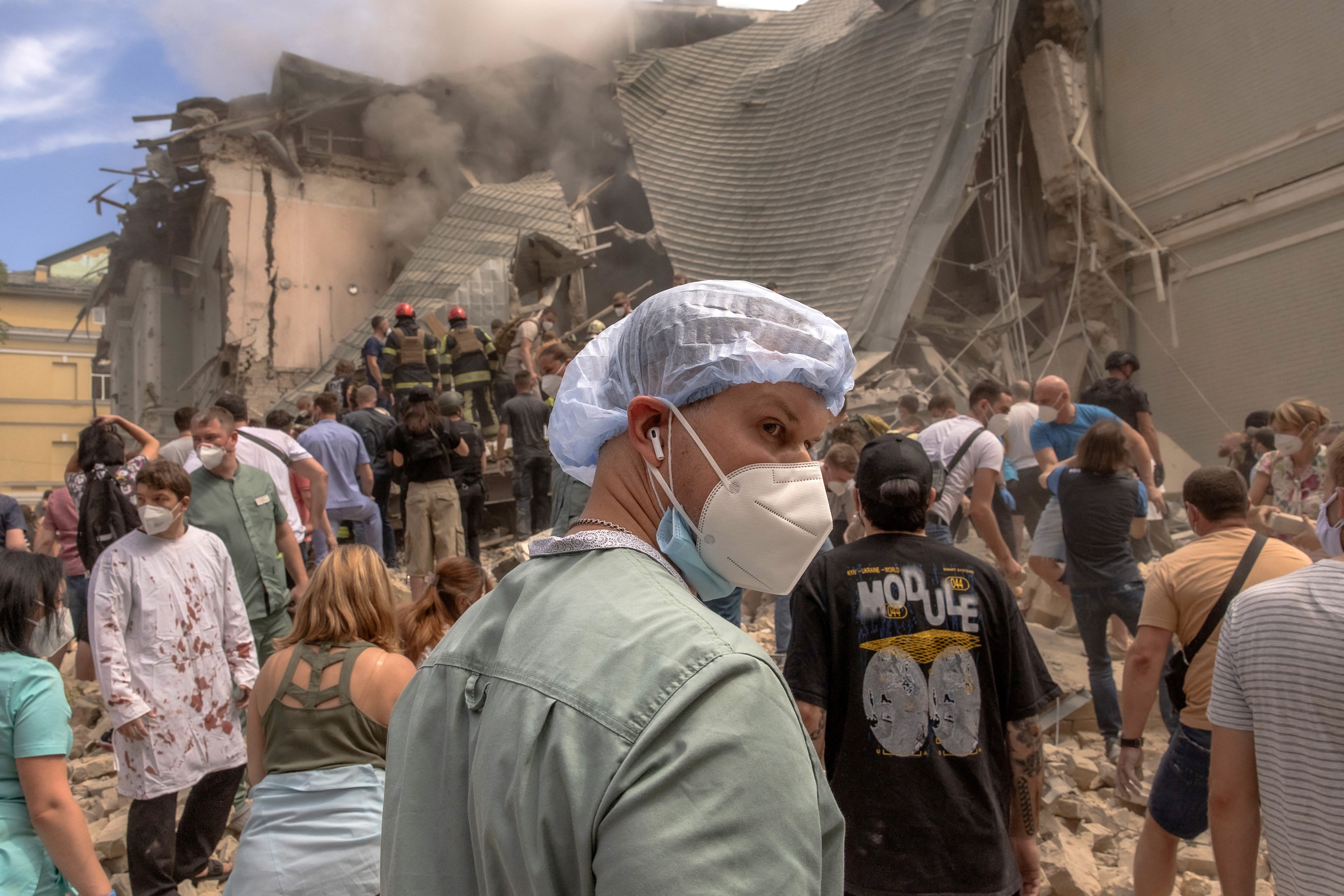
Russia damaged or destroyed 3,000 private homes since July 2024 alone as a result of medium-range drone strikes in the Kherson, Mykolaiv, and Dnipropetrovsk regions.
Russia has not only destroyed property but also seized it. A total of 26,697 private properties in temporarily occupied territories have been classified as “abandoned” by Russian authorities—a step toward confiscation—including 12,191 apartments in the occupied city of Mariupol between December 2024 and June 2025.
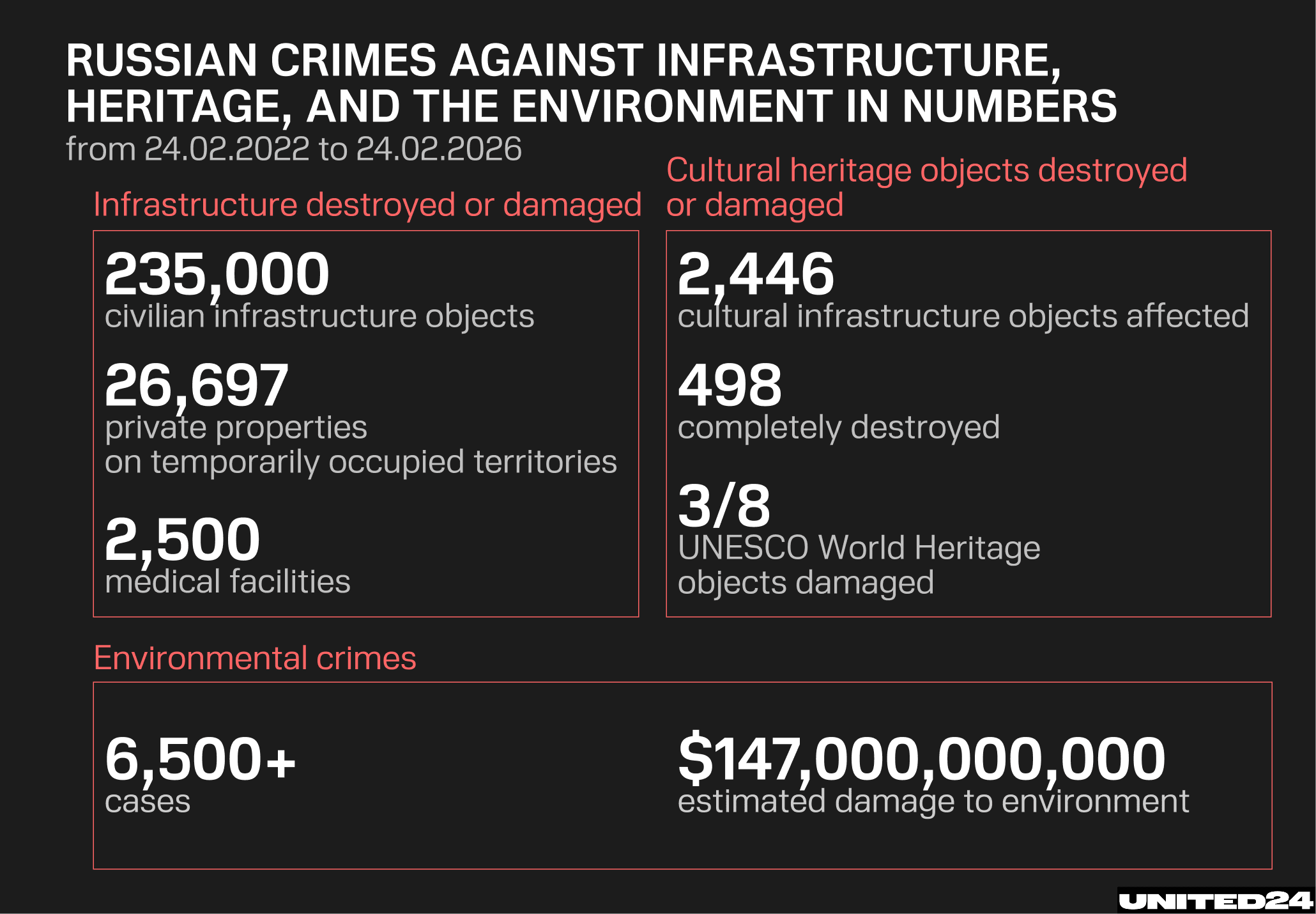
The destruction caused by Russia has also affected the environment in ways that are less visible but often irreversible. More than 6,500 environmental crimes committed by Russia have been recorded since the beginning of the invasion, with damages estimated at $147 billion.
The Russian strike on the Kakhovka Hydroelectric Power Plant triggered massive flooding, submerging 63,447 hectares of forest and affecting 1,144 households. It also reduced the reservoir’s water volume by 14.395 cubic kilometers. Overall damage from the incident is estimated at $14 billion. Its reconstruction could take up to 7 years and cost about $5.4 billion after the liberation of the surrounding areas.
-6a831ba8208ee2b72860a2631c8ff8f7.jpg)
Russia has damaged or destroyed 1,685 cultural heritage sites since the start of its full-scale invasion, Ukraine’s Ministry of Culture and Information Policy documented on February 16, 2026. An additional 2,446 cultural infrastructure facilities—including cultural centers, libraries, and art schools—have been affected, of which 498 were completely destroyed. Among them are 854 damaged libraries and 136 museums and galleries.
Russia has also damaged three of Ukraine’s eight UNESCO World Heritage sites. In response, 46 sites in Ukraine now benefit from the highest level of UNESCO enhanced protection, a status intended to prevent further destruction and ensure accountability.
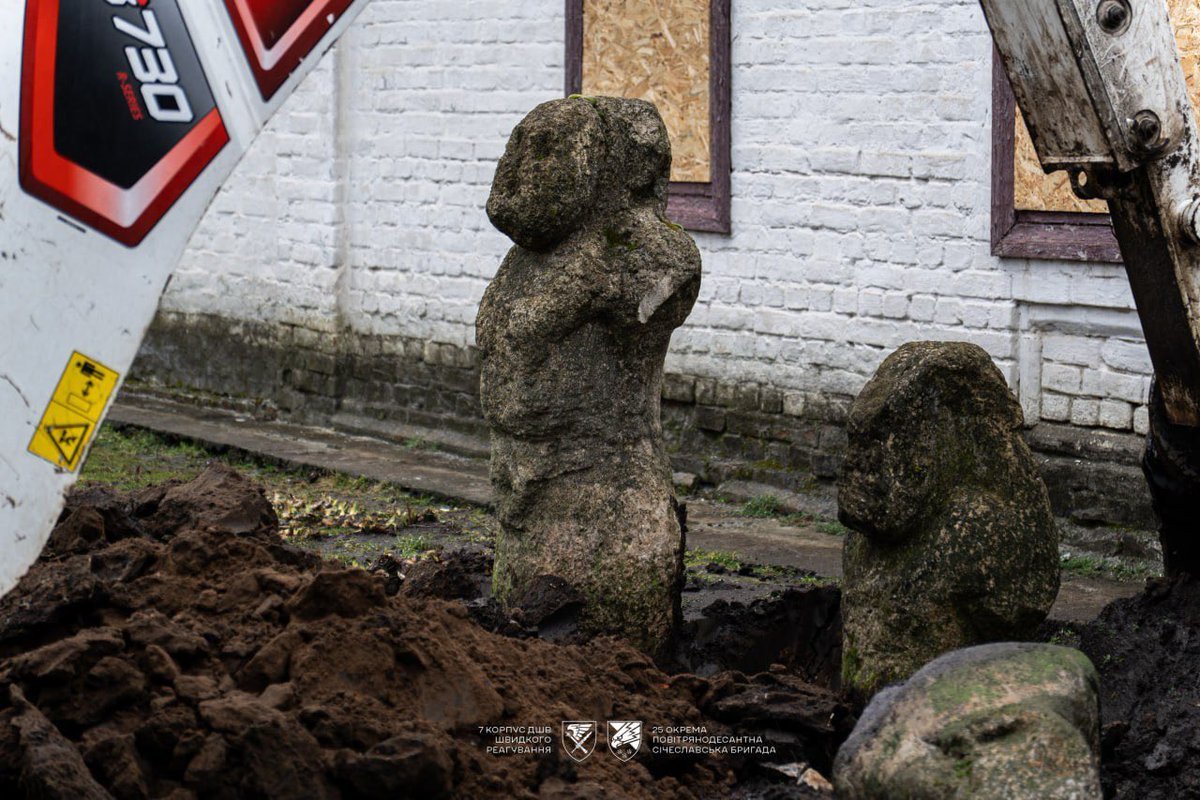
At the same time, Ukraine is taking steps to protect its cultural assets from destruction or theft. Ukrainian paratroopers evacuated 11th–13th century Polovtsian stone statues from areas near the frontline in eastern Ukraine, Army Media reported on February 18, 2026. The operation was carried out by the 25th Airborne Brigade in coordination with museum workers and volunteers to safeguard these historic monuments from Russian shelling. The steles will be preserved in Dnipro until the security situation improves.
Russia’s massive losses for minimal territorial gains
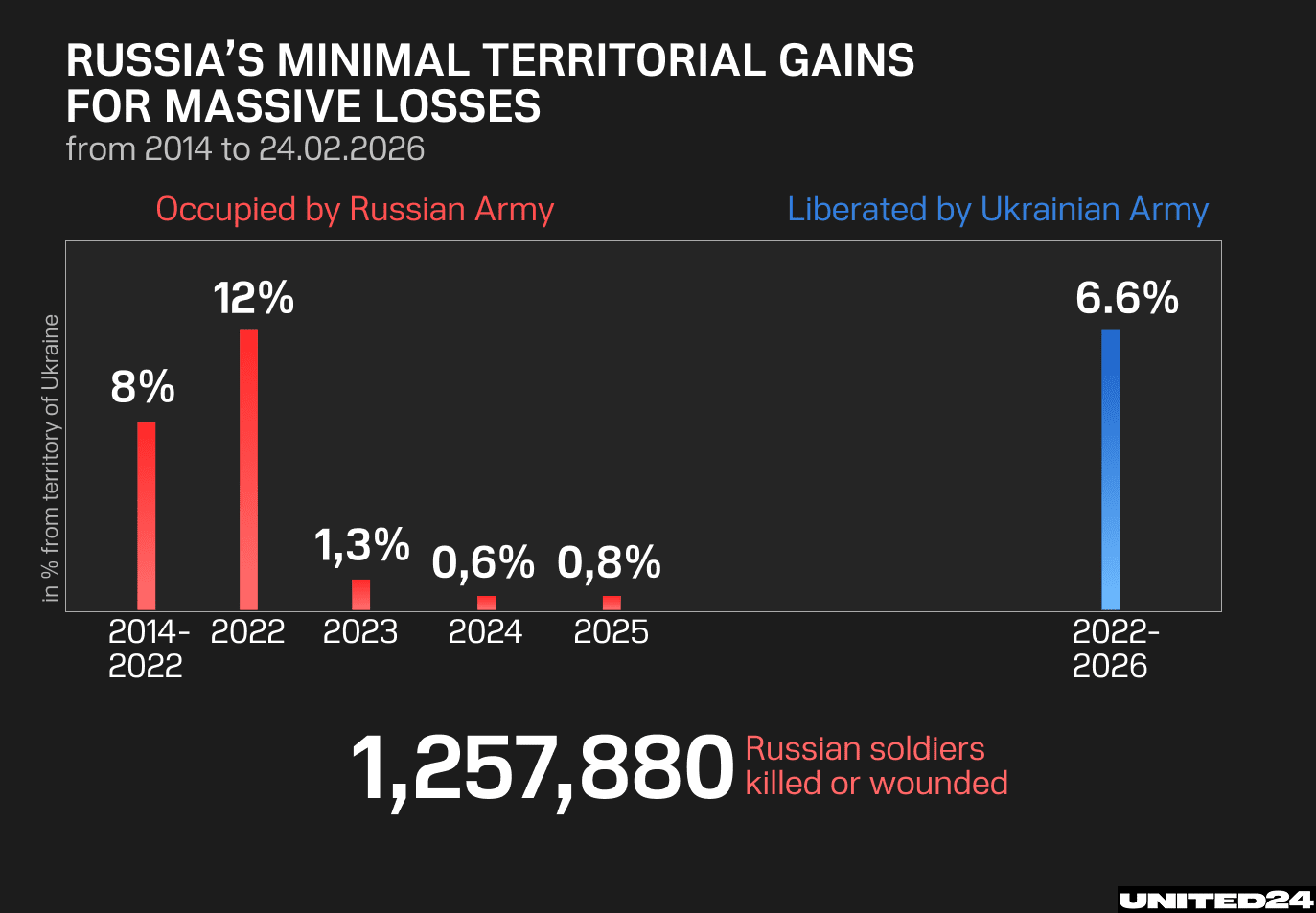
On the Russian side, the human cost of the war is without parallel since World War II. As of February 20, 2026, Russian losses have reached at least 1,257,880 soldiers killed or wounded. These figures, confirmed by international sources, stand in stark contrast to the limited amount of Ukrainian territory Russia has managed to occupy—12% since 2022 and just 1.3% since 2023.
Estimates of Russian soldiers killed range from 275,000 to 325,000. Independent media outlets Mediazona and the BBC have formally identified 177,433 of those killed by analyzing open-source data that documents them by name, while noting that the real number is significantly higher.
Russia’s casualty rates surged as the conflict turned into a war of attrition. The country suffered approximately 430,000 losses in 2024 and about 415,000 in 2025.
Russia controls roughly 116,000 to 120,000 square kilometers of Ukrainian territory as of January 2026, representing about 19.25% to 20% of the country, as calculated by the Center for Strategic and International Studies (CSIS). This includes territories seized before the full-scale invasion in 2022, such as the Crimean Peninsula and parts of the Donetsk and Luhansk regions.
At the peak of the initial invasion in March 2022, Russian forces had quickly captured around 115,000 square kilometers. However, Ukrainian counteroffensives forced them to withdraw from approximately 75,000 square kilometers by the end of 2022.

Overall, Russia today controls a net gain of roughly 75,000 square kilometers (about 12% of Ukraine) directly resulting from the 2022 invasion.
They are really losing 156 people to occupy one kilometer of our land. And we also have our offensive steps, and then they lose it.
Volodymyr Zelenskyy
President of Ukraine
The data shows that since the front lines stabilized in late 2022, Russia has paid an extraordinary human price for extremely limited territorial gains:
A slow advance over three years (2023–2026): From January 1, 2023, to January 1, 2026, Russia captured only 7,463 square kilometers in total (around 1.28% of Ukraine’s territory).
2024: Russia lost more than 430,000 soldiers (killed and wounded) while capturing only about 3,600 square kilometers (roughly 0.6% of Ukraine).
2025: Russia lost another approximately 415,000 soldiers while capturing just 4,336 to 4,831 square kilometers (around 0.72% to 0.8% of Ukraine).
They want us to perceive the Russians as a mighty bear, but you could argue that they are moving through Ukraine at the speed of a garden snail. Let’s not fall into the trap of Russian propaganda.
Mark Rutte
NATO Secretary General
To put this into perspective, military analysts note that during major offensives over the past two years—such as those toward Pokrovsk and Chasiv Yar—Russian forces advanced at historically slow rates of just 15 to 70 meters per day. In exchange for these marginal gains, Russia has sustained the highest casualty rate of any major power in a war since World War II.
Precision drone warfare has sharply increased the lethality of Ukrainian strikes, pushing casualty ratios in some sectors as high as 1 to 27. Even as Russia continues to recruit volunteers, conscripts, and foreign fighters, the current pace of losses—projected by the Minister of Defense of Ukraine Mykhailo Fedorov to reach up to 60,000 per month—raises serious questions about the sustainability of its offensive operations without a politically risky mass mobilization.
Discuss this article:
-4a56a6b482ec132402c16ef6fcabf9a2.png)